

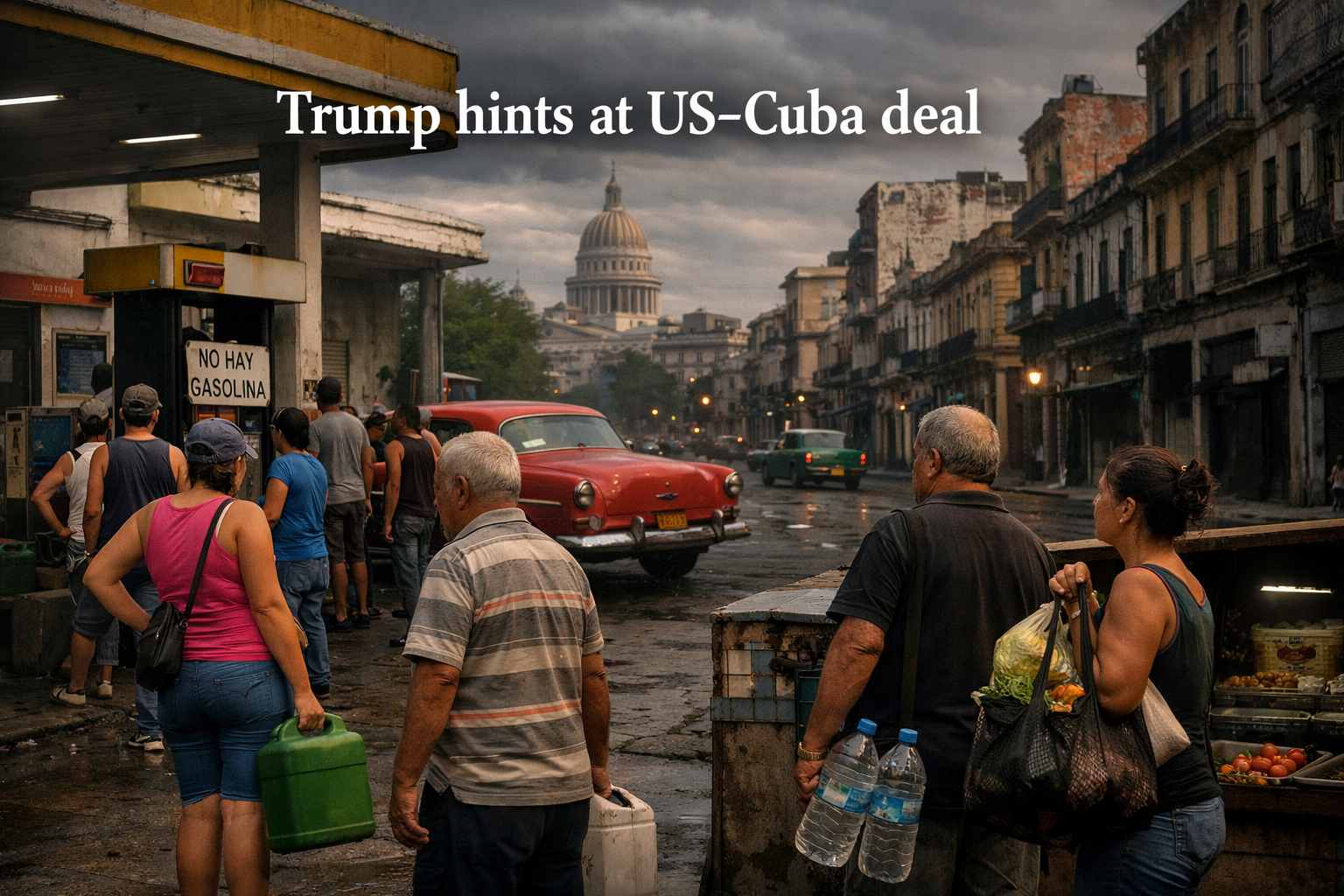
Former U.S. President Donald Trump has hinted that Washington may consider reaching an agreement with Cuba, a statement that has sparked debate amid one of the island’s most difficult economic periods in decades. While Trump did not outline any clear roadmap or timeline, his remarks come at a moment when Cuba is facing fuel shortages, rising prices, and growing pressure from U.S. policy moves.
Speaking to reporters while traveling aboard Air Force One, Trump suggested that Cuba might be forced to negotiate due to its worsening economic conditions. He argued that the crisis gripping the country was avoidable and blamed Havana’s long-standing reliance on foreign oil and financial support, particularly from Venezuela.
Rising Pressure on Cuba
Trump’s comments follow recent warnings that the United States could impose tariffs on countries supplying oil to Cuba. Such measures have already had ripple effects. Venezuela, once Cuba’s primary oil lifeline, has significantly reduced shipments, leaving the island struggling to meet its daily energy needs. Mexico, which stepped in after Venezuela scaled back supplies, is now reportedly reconsidering its role due to fears of U.S. retaliation.
For Cuba, the timing could not be worse. Fuel shortages have disrupted electricity generation, transportation, and basic services. Power cuts, already common in rural areas, are increasingly affecting Havana, the country’s political and economic heart.
Life Getting Harder for Ordinary Cubans
Across the island, daily life has become a test of endurance. Long blackouts, limited public transport, and soaring food prices have pushed many families into survival mode. Residents say that securing essentials like cooking fuel, water, and groceries now dominates everyday routines.
The Cuban peso has weakened sharply against the U.S. dollar, driving up the cost of imported goods. At the same time, fuel is often sold only in dollars at premium prices—placing it out of reach for most citizens who are paid in local currency.
Public transportation has also taken a hit. Some buses have been taken off the roads, while private taxi operators have raised fares or shut down entirely due to fuel costs. For workers, this has meant fewer job opportunities and longer, more expensive commutes.
Why Protests Remain Limited
In many countries, such conditions might trigger widespread demonstrations. In Cuba, however, large-scale protests remain rare. Analysts point to strict controls on dissent, combined with years of economic hardship that have left people focused more on survival than mobilization.
The last major wave of protests occurred in 2021, during the pandemic, when the economy contracted sharply. Since then, mass emigration—estimated in the millions—has further weakened any organized domestic opposition.
Many Cubans are also reluctant to speak openly about politics. When asked about the possibility of protests, residents often avoid direct answers, reflecting both fear and uncertainty about the future.
Could a U.S.–Cuba Deal Change Anything?
Trump’s suggestion of a possible deal raises questions about what, if anything, could realistically improve conditions on the ground. Any agreement would likely involve negotiations over sanctions, trade, and political concessions—areas that have historically been deeply contentious.
Cuban officials have pushed back strongly against U.S. pressure. The country’s foreign minister recently described the tariff threats as an “extraordinary danger,” warning that they could worsen an already fragile humanitarian situation.
For ordinary Cubans, the hope is simple: stability. Whether through eased sanctions, restored fuel supplies, or improved access to goods, many are less concerned with political posturing and more focused on immediate relief.
The Road Ahead
For now, Trump’s remarks remain just that—remarks. Without concrete policy announcements, uncertainty continues to dominate Cuba’s outlook. What is clear, however, is that economic pressure is reshaping daily life across the island, and any shift in U.S. policy could have far-reaching consequences.
As fuel shortages deepen and prices climb, Cubans wait to see whether diplomacy—or further confrontation—will define the next chapter of their country’s long and complicated relationship with the United States.
